

| 02 |
Estimating cellular interactions from patternsModeling biological development with agent simulation 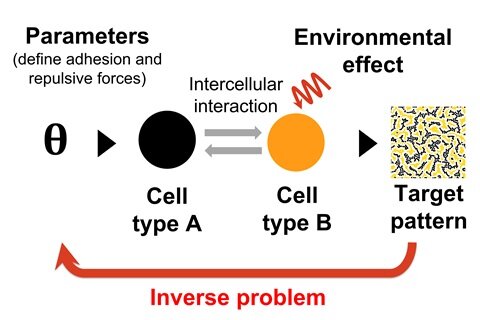
|
|---|
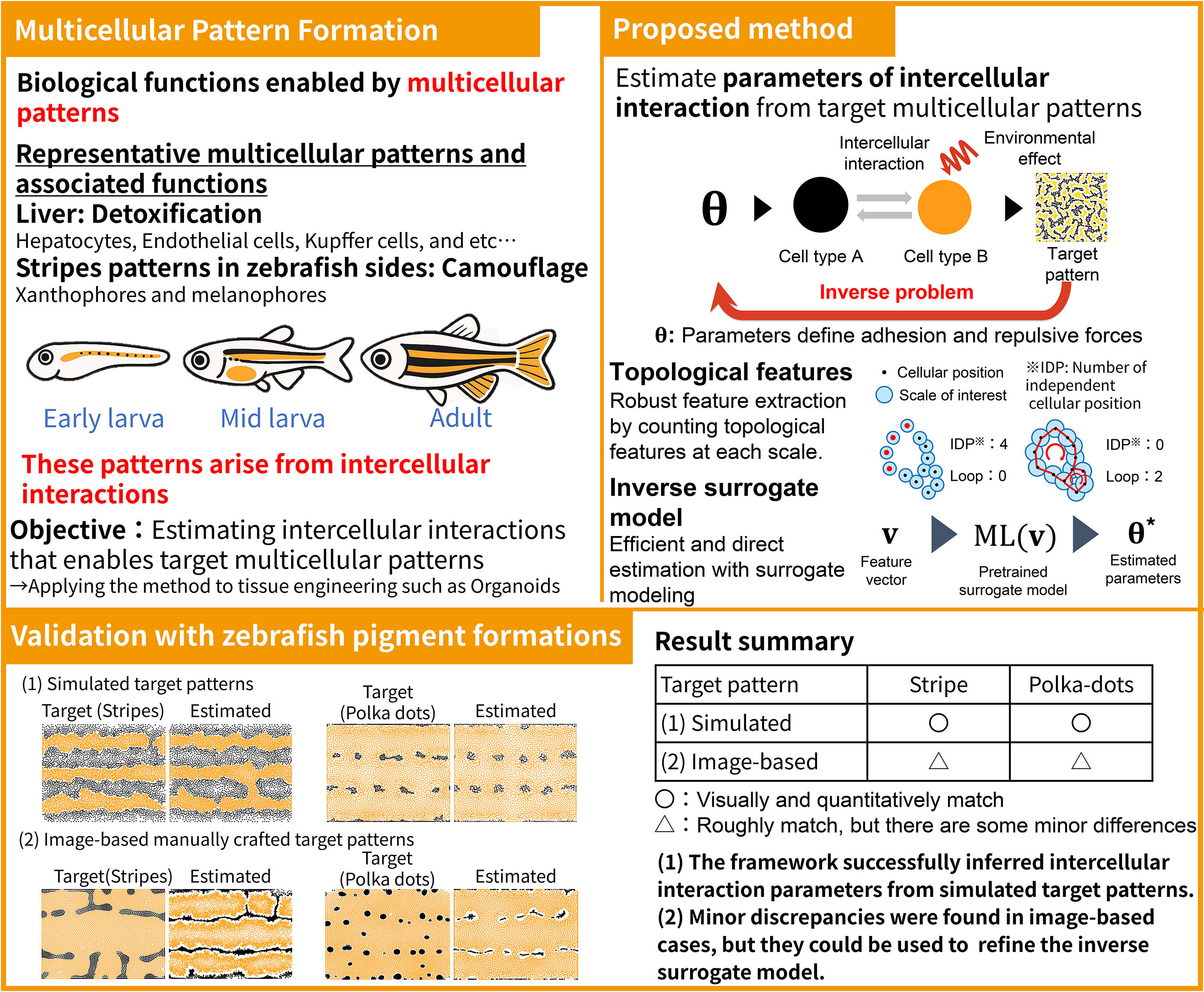
Self-organized multicellular patterns emerging from intercellular interactions are fundamental to diverse biological functions, such as detoxification in hepatic lobules and camouflage through stripe patterns in zebrafish skin. However, quantitatively inferring the underlying intercellular interactions that give rise to target multicellular patterns remains a challenging inverse problem. In this study, we propose a framework that estimates parameters governing adhesion and repulsive forces between cell types directly from target multicellular patterns. Our method extracts robust topological features across multiple spatial scales and employs a pretrained surrogate model to efficiently infer interaction parameters. We validate the framework using both simulated and image-based zebrafish pigment patterns. This framework provides an efficient and interpretable approach for linking multicellular pattern geometry to intercellular interactions and has potential applications in tissue engineering, including the design and control of organoid morphogenesis.
[1] A. K. Jin, K. Komiya, R. Nishikimi, K. Kashino, “Topology Informed Surrogate Modeling for Parameter Optimization in Multicellular Models,” in Proc. International Conference on Biomedical and Health Informatics (BHI), 2025.
[2] K. Komiya, A. K. Jin, R. Nishikimi, K. Kashino, “Learning Pairwise Potential via Differentiable Recurrent Dynamics,” in NeurIPS Workshop on Machine Learning and Physical Science, 2025.
Kenji Komiya, Biomedical Informatics Research Group, Media Information Laboratory