

| 06 |
Who is affected by this policy, and why?Accurate, interpretable statistical causal effect estimation 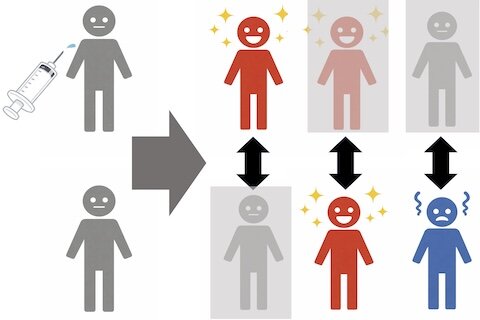
|
|---|
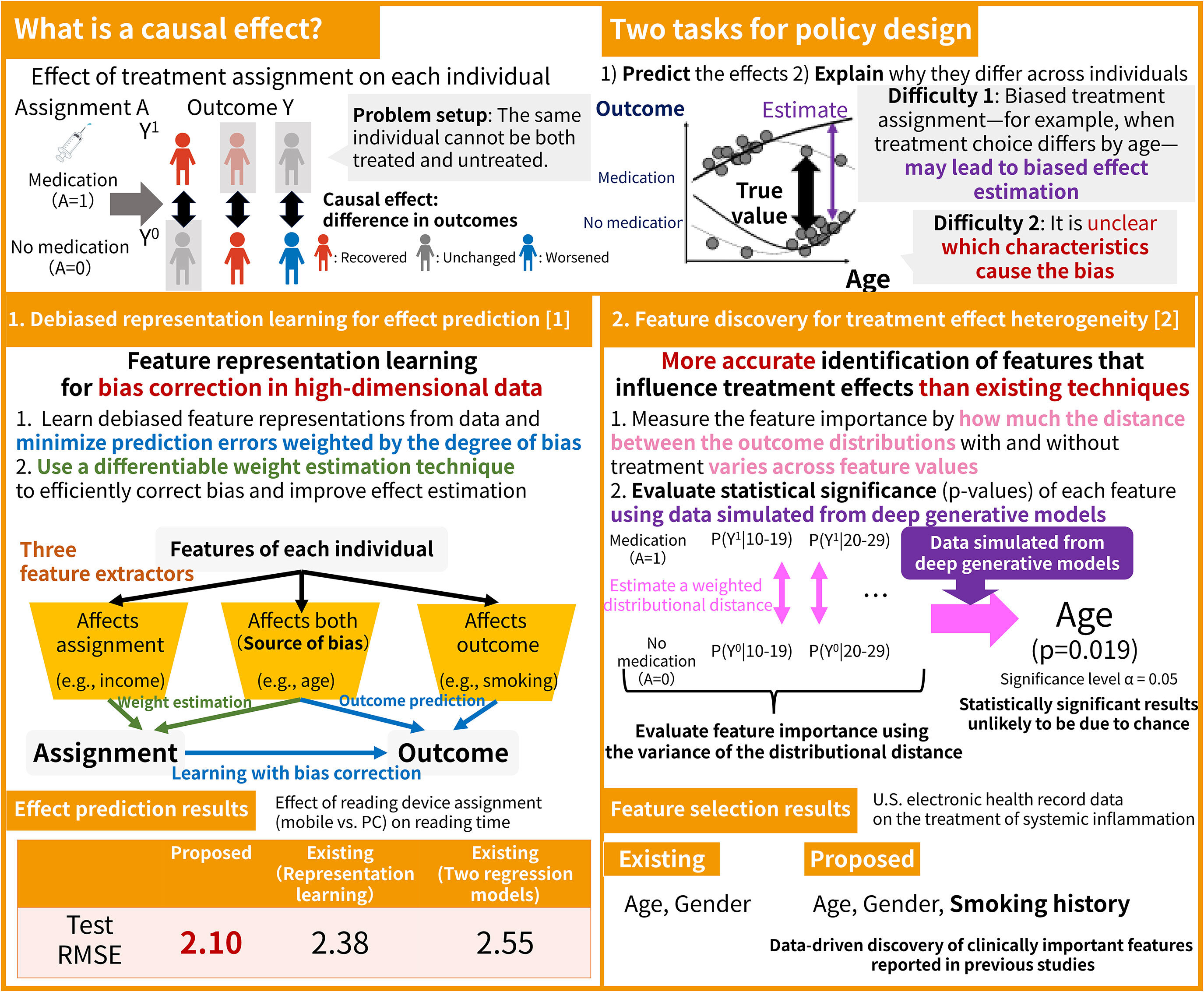
To design important, individualized interventions such as medical treatments and targeted advertising, we need to understand who benefits from a policy, by how much, and why. We develop two methods for this goal. The first method focuses on accurate effect estimation. It aims to improve the prediction of outcomes with and without treatment by detecting and correcting hidden correlations between treatment assignment and outcomes—for example, when older patients are less likely to receive risky surgery and also tend to have worse outcomes. The second method focuses on explanation. It identifies which personal characteristics account for differences in treatment effects across individuals, while assessing the statistical significance of each characteristic. Compared with simple machine learning techniques that rely only on observed correlations, these methods aim to evaluate the treatment effects more accurately by capturing cause-effect relationships. By building accurate and interpretable causal effect estimation techniques that work even with limited data, our research aims to support data-driven decision-making in high-stakes settings. Ultimately, we hope this research will contribute to a future in which important decisions can be tailored more precisely, reliably, and effectively to each individual.
[1] Y. Chikahara, K. Ushiyama, “Differentiable Pareto-Smoothed Weighting for High-Dimensional Heterogeneous Treatment Effect Estimation,” Proc. of The 40th International Conference on Uncertainty in Artificial Intelligence (UAI ‘24), 2024.
[2] Y. Chikahara, M. Yamada, H. Kashima, “Feature Selection for Discovering Distributional Treatment Effect Modifiers,” Proc. of The 38th International Conference on Uncertainty in Artificial Intelligence (UAI ‘22), 2022.
[3] S. Horii, Y. Chikahara, “Uncertainty Quantification in Heterogeneous Treatment Effect Estimation with Gaussian-Process-Based Partially Linear Model,” Proc. of The 38th AAAI Conference on Artificial Intelligence (AAAI ‘24), 2024.
[4] T. Iwata, Y. Chikahara, “Meta-learning for heterogeneous treatment effect estimation with closed-form solvers,” Machine Learning, Vol. 113, pp. 6093-6114, 2024.
Yoichi Chikahara, Learning and Intelligent Systems Research Group, Innovative Communication Laboratory