

| 05 |
Fast and accurate event timing predictionEvent time analysis via point processes and machine learning 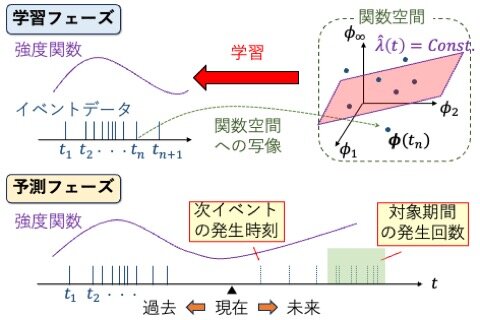
|
|---|
If the timing of future events can be predicted, risks can be mitigated through proactive preparation, or opportunities can be fully leveraged. In this study, we present a method for efficiently predicting future event times by leveraging point processes and machine learning. While existing approaches achieve high predictive accuracy, they often require substantial computational cost during training. To address this issue, we replace the conventional log-likelihood objective with the least squares contrast for point processes, enabling up to several hundred-fold speedups in training while maintaining comparable predictive performance. This improvement makes our method scalable to large datasets. As machine learning-based event prediction becomes increasingly accurate with the growing volume of data, the associated computational burden also continues to rise. Our approach, which efficiently handles large-scale event series data, aims to support proactive decision-making by accurately predicting when events such as equipment failures or demand fluctuations will occur.
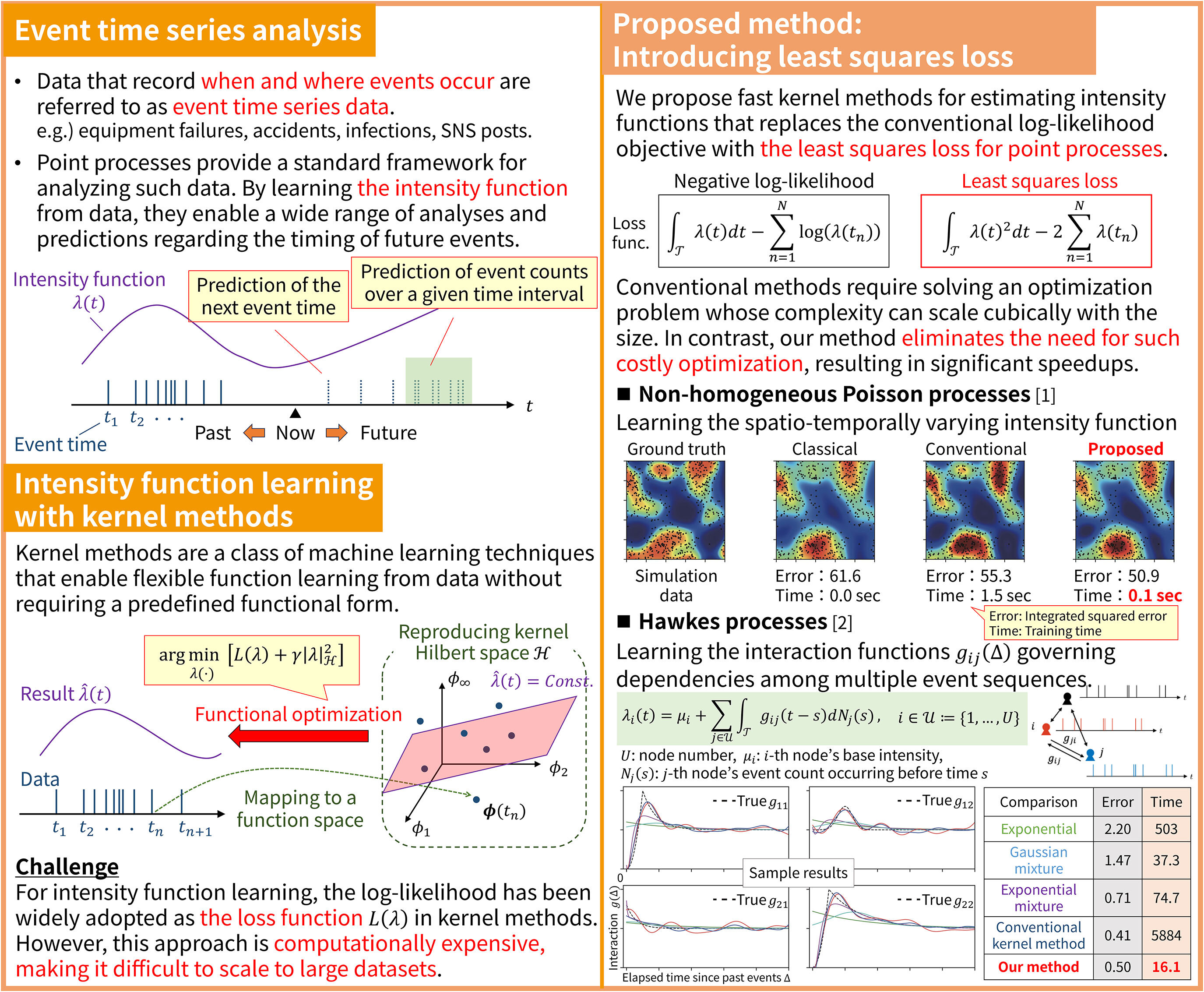
[1] H. Kim, T. Iwata, A. Fujino, “K2IE: Kernel method-based kernel intensity estimators for inhomogeneous Poisson processes,” in Proc. The 42nd International Conference on Machine Learning (ICML), 2025.
[2] H. Kim, T. Iwata, “A representer theorem for Hawkes processes via penalized least squares minimization,” in Proc. The 14th International Conference on Learning Representations (ICLR), oral, 2026.
Hideaki Kim, Learning and Intelligent Systems Research Group, Innovative Communication Laboratory