

| 03 |
Towards energy-efficient AI modelsIntegrating sparsity and quantization for model compression 
|
|---|
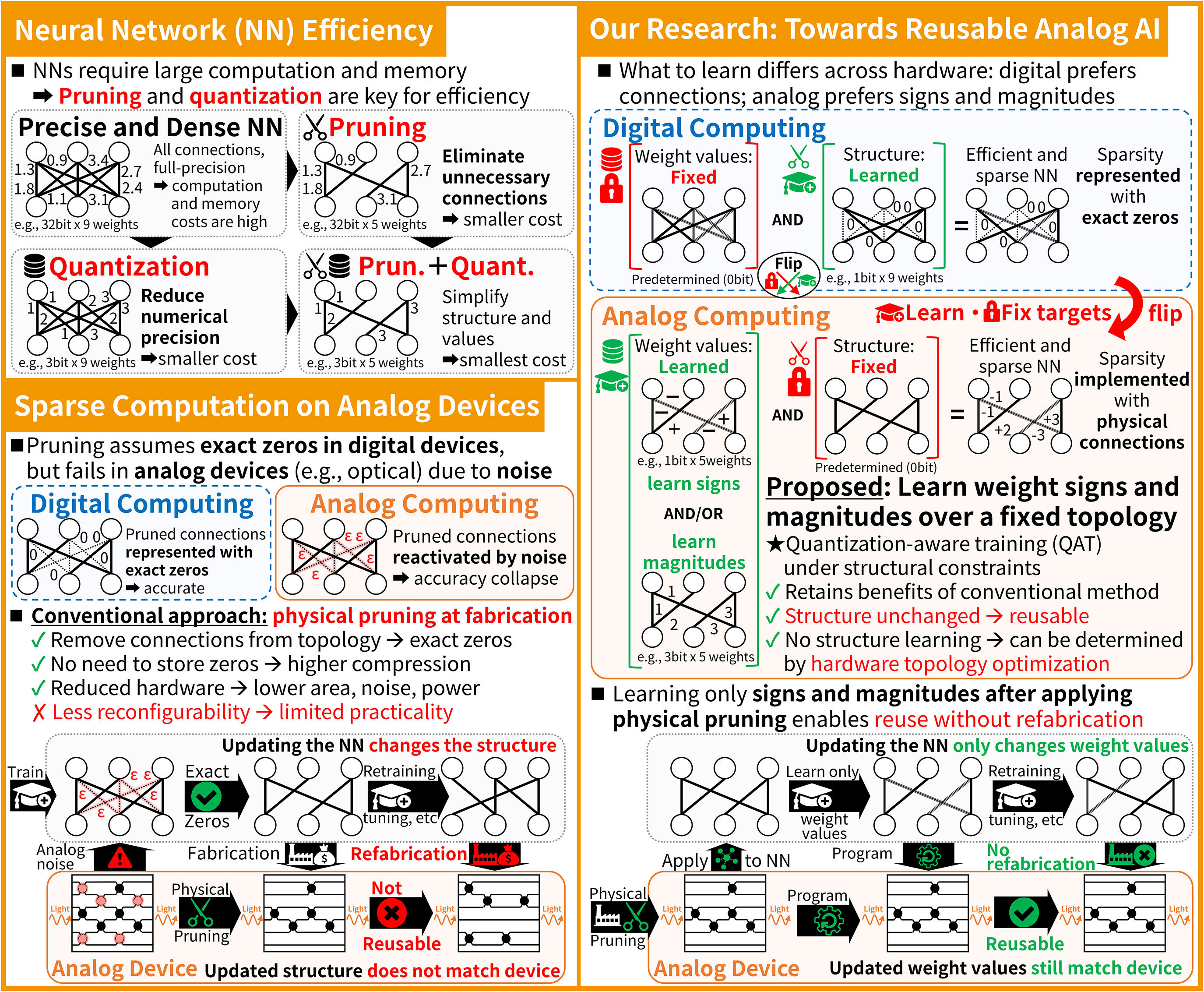
The increasing performance of AI models has led to growing computational cost and energy consumption, motivating efficiency techniques such as sparsity and quantization. However, conventional approaches often rely on their combined use, which can restrict deployment to digital hardware that efficiently supports sparse computation. In this work, we present a training framework that does not require learned sparsity, while remaining compatible with learned quantization. This enables neural networks to be flexibly deployed across a wider range of hardware platforms, including energy-efficient analog devices where sparsity is difficult to exploit. By decoupling model efficiency from specific structural constraints, our approach broadens the applicability of model compression. Ultimately, this work aims to support the development of energy-efficient, reconfigurable AI systems that can operate across diverse computational substrates, from digital to emerging analog hardware.
[1] Á. López García-Arias, Y. Okoshi, H. Otsuka, D. Chijiwa, Y. Fujiwara, S. Takeuchi, M. Motomura, "The Trichromatic Strong Lottery Ticket Hypothesis: Neural Compression With Three Primary Supermasks," Workshop on Machine Learning and Compression, Conference on Neural Information Processing Systems (NeurIPS), 2024.
[2] Á. López García-Arias, Y. Okoshi, H. Otsuka, D. Chijiwa, Y. Fujiwara, S. Takeuchi, M. Motomura, “The Trichromatic Strong Lottery Ticket Hypothesis: A Unifying View of Supermask-Based Learning,” IEEE International Joint Conference on Neural Networks (IJCNN), 2026.
Ángel López García-Arias, Recognition Research Group, Media Information Laboratory