
| 22 |
How people make sense of non-realistic virtual worldsExamining how a sekai-kan is formed in the human mind 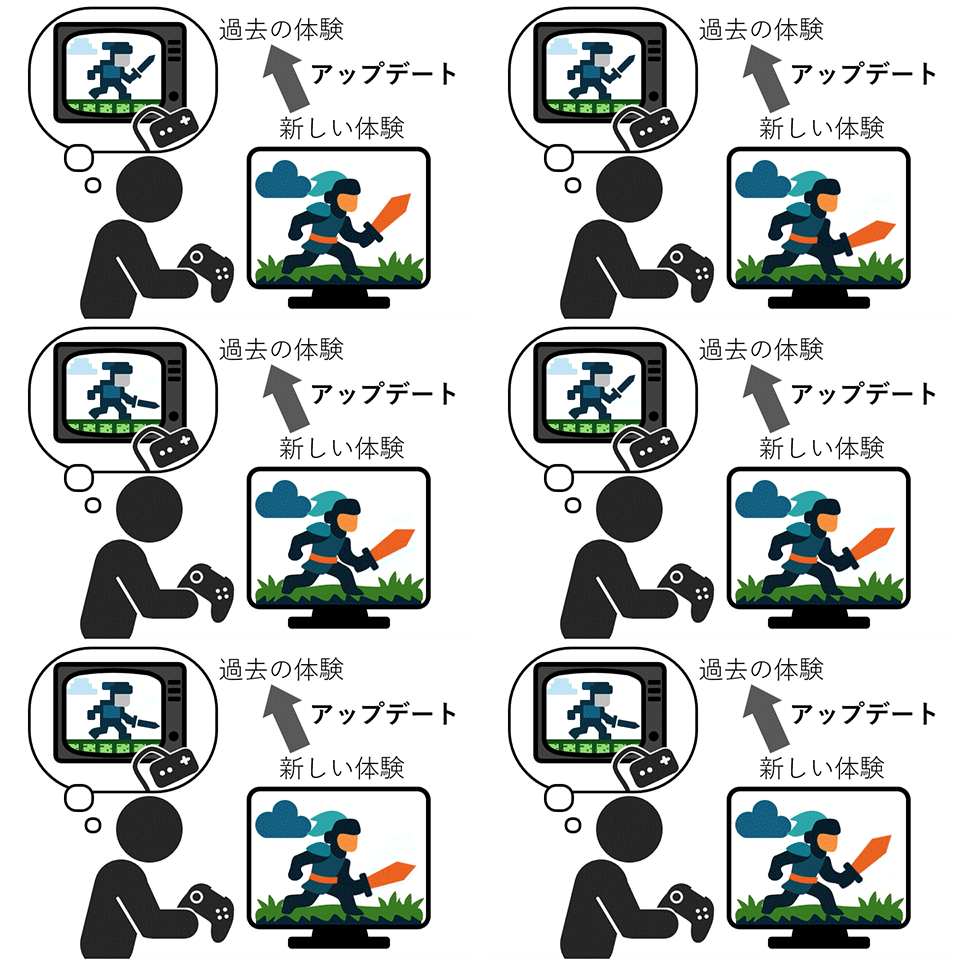
|
|---|
People encounter events that violate physical laws in virtual worlds, yet they do not simply treat them as something they cannot understand. Instead, they make sense of how that world works by drawing on past experiences and evaluations. This study investigates how people form an understanding of virtual worlds. We developed a questionnaire scale to measure player experience in video games that contain many non-realistic events, enabling us to empirically examine the process of understanding. Using this scale, we found that experiencing a new game can reshape how previously experienced worlds are evaluated, a phenomenon we call a retrospective effect. These findings provide a basis for designing virtual worlds that people can naturally engage with, supporting more immersive learning and training experiences that promote lasting behavioral change.
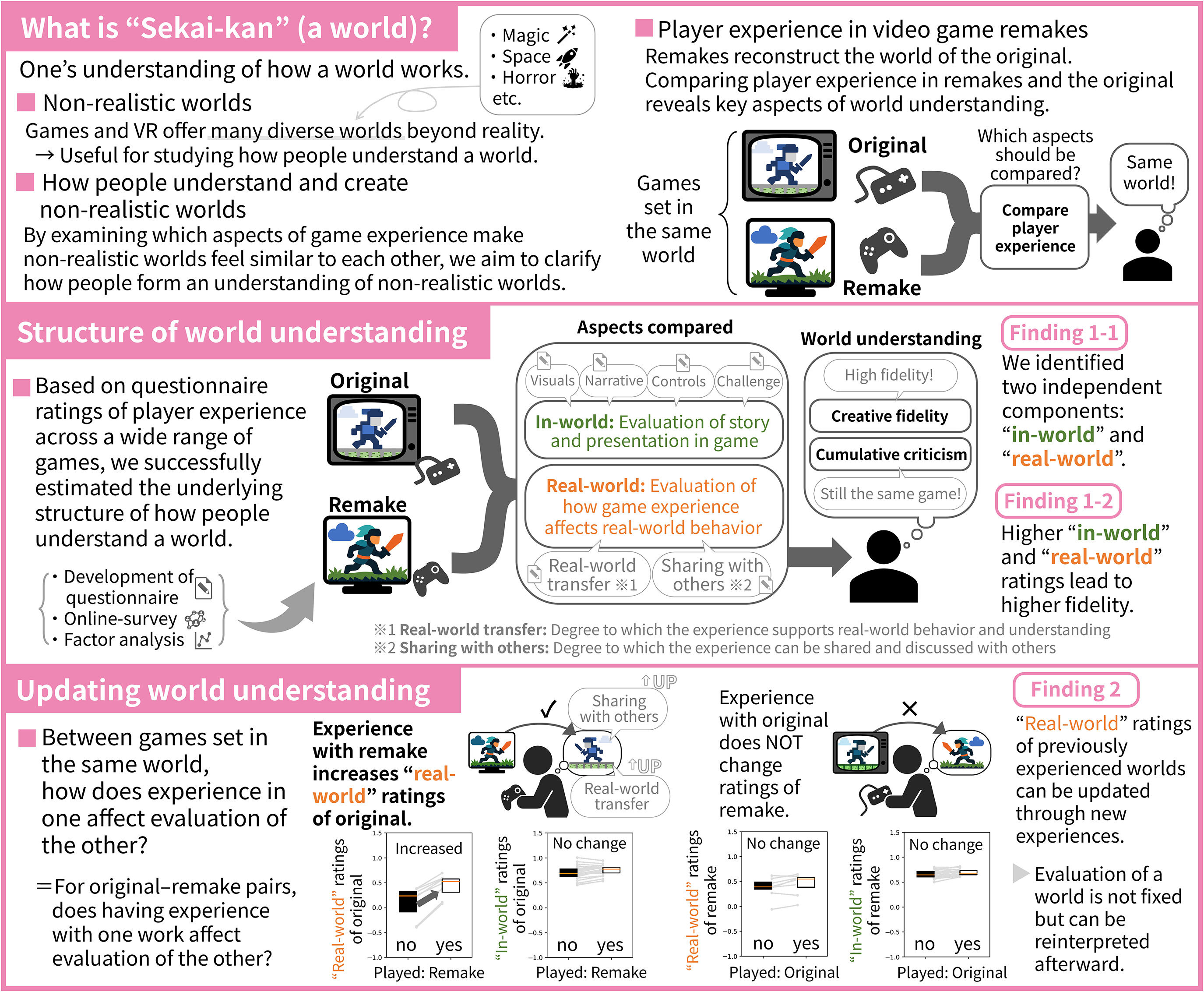
[1] T. Yokosaka, K. Miura, Y. Isogaya, T. Ohtani, K. Maruya, “Factors of player experience in describing the relationship between remade and original works,” 2024 IEEE Conference on Games (CoG), pp. 1-4, 2024.
[2] T. Yokosaka, Y. Isogaya, T. Ohtani, K. Maruya, “Video-Game Retrospective Effect: How Playing Remakes Alters Experience Evaluations for Original Works,” In Companion Proceedings of the Annual Symposium on Computer-Human Interaction in Play, pp. 203–208, 2025.
Takumi Yokosaka, Sensory Representation Research Group, Human Information Laboratory